
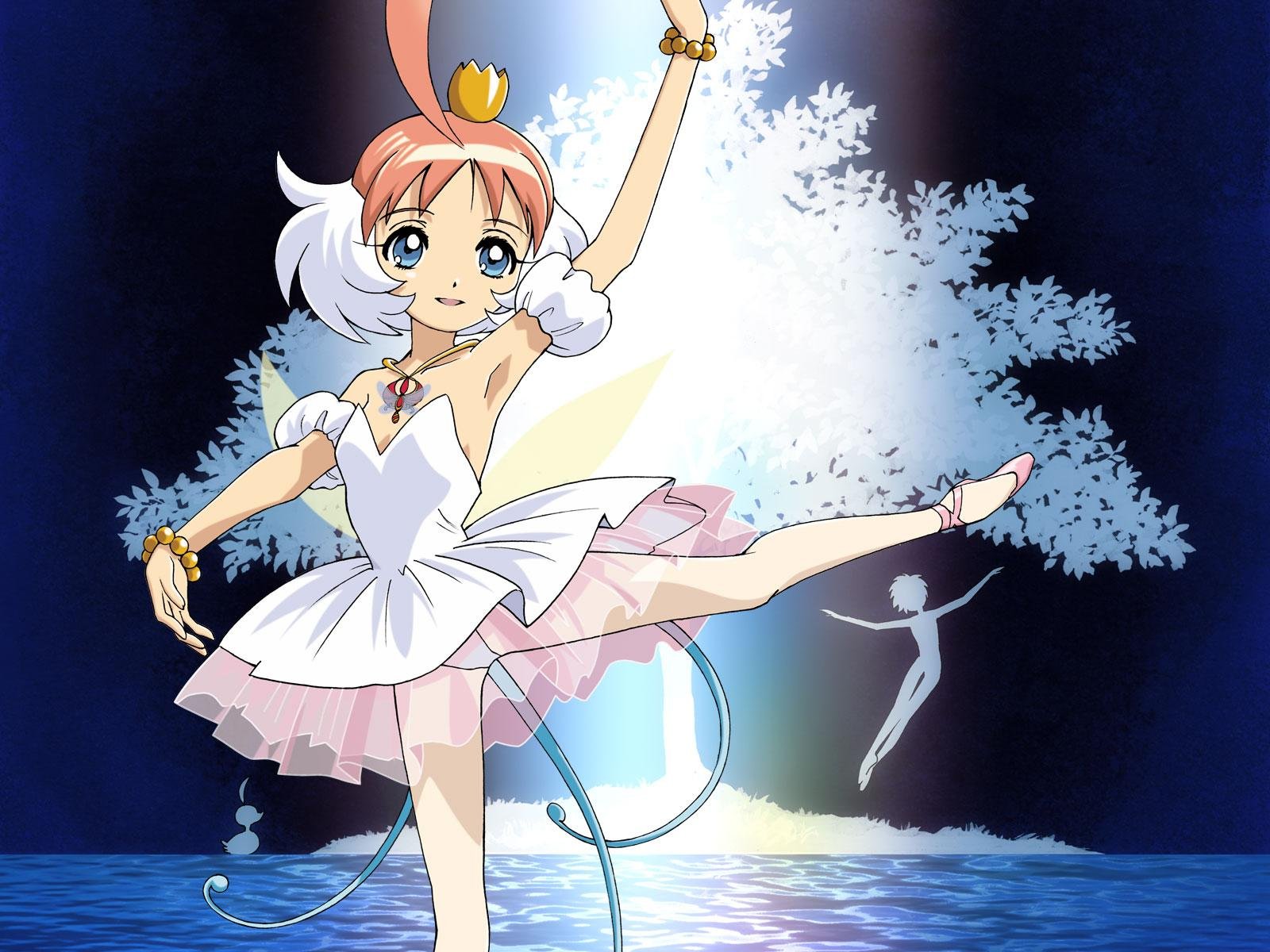
My favorite anime series has remained unchanged since 2004: Princess Tutu.
Created by Ikuko Itoh and Junichi Sato—the minds behind classics like Sailor Moon, Kaleido Star, and Prétear—Princess Tutu remains one of the most emotionally rich and artistically ambitious magical girl anime ever made. Itoh’s extensive history as a character designer on Sailor Moon and Sato’s directorial work on its earliest seasons helped shape a series unlike anything else.
But before we get into the figure itself, some backstory.
At Ushicon 2019, I had the incredible opportunity to meet Jay Hickman (the North American voice actor for Mytho), Ikuko Itoh, Junichi Sato, and Yasuno Sato, the series’ music coordinator.

During the panel, Itoh-sensei revealed that the seeds of Princess Tutu were planted as far back as 1994 while she was working on Sailor Moon. She often listened to Tchaikovsky’s The Nutcracker and other classical pieces used in films and commercials, but her deeper inspiration came even earlier.
As a child, her father would play Swan Lake at home. Too young to read the album notes, she constantly interrupted him with questions about the story—questions he could only answer for so long before finally telling her to be quiet and simply listen. So she did.
And in that silence, she imagined.
That childhood habit of building stories from music stayed with her into adulthood. Later, when she needed inspiration while working in animation, she would return to ballet compositions to deepen her imagination.
Eventually, while designing characters for Magic User’s Club, Junichi Sato asked her what she personally wanted to draw. Her answer was simple:
A girl in a tutu.
That sketch would eventually become Princess Tutu.
It would take years for that dream to materialize, but when it finally did, it became something special.

The giant vacuum tube stereo was in my house ever since I could remember. It had a space carefully set aside for it as if it were a precious family treasure. When I was around 5 or 6, my father would enjoy his favorite classical music when he came home from work, and as little as I was, I would also listen nearby. Of those, Tchaikovsky’s Swan Lake, in particular, caught my attention. I was still unable to read the explanation on the album jacket, so I pestered my father with questions. “What’s Odette doing right now? What happened to the prince?” I seem to recall that he gave me vague explanations towards the beginning, but my questions must have been difficult to answer for my father, who was not especially knowledgeable about ballet. Soon, I was sternly told to “be quiet and listen!” I stopped asking questions. I had to decide that I would imagine whatever stories I pleased as I listened to the music.
Perhaps it was a habit I picked up then, but even after I began working on anime, if I needed a little “boost,” I would listen to ballet music to deepen my imagination and raise morale. I began to seriously think about things like “why do the Japanese like Tchaikovsky?” And about the “soothing effect” of classical music that is used repeatedly in television commercials. I came to feel strongly about thinking, “Is there no way to produce an animation that uses only the familiar and nostalgic classical music?”
When Sailor Moon S began, Mr. Junichi Sato, with whom I would later have a long-lasting working relationship, asked me to do the character designs for Magic User’s Club, and I had a tough time with it. This was because I did not know what kind of direction I should go with for the drawings. That was when I asked, “If it were up to me, what would I want to draw?” And what I drew then for the first time was a maiden in a tutu… that was “Princess Tutu.” Having taken a liking to that image, I decided to start building a story as I worked on Magic User’s Club. As the story came together, I would have staff members I knew well to listen to what I had, and gradually built up my dream. Eventually, there was talk of “Why don’t you make characters and form a plot?”… It took a considerable number of years since then for it to actually become a show, but we have finally been able to bring it to you as the DVD you have here. Please enjoy the details of the music and the images created together with a wonderful staff with all our hearts.
At home, that giant vacuum tube stereo is still in its special place. The stereo has become timeworn and no longer plays music, but the music from that time still continues to flow in my memories, and my heart still continues to dance.
– Ikuko Itoh, on the conceptualization of Princess Tutu

At this same convention Yasuno Sato, the music coordinator for the series and wife of Junichi Sato explained that Itoh-sensei’s love of “The Nutcracker,” resulted in the use of “The Nutcracker Overture,” as Ahiru’s, the main character of Princess Tutu, character theme song. Thus, bringing the origin and the series itself full circle.

Princess Tutu begins like a fairy tale:
Once upon a time, there was a man who died—but before his death, he wrote a story about a fearsome raven and a courageous prince locked in eternal battle. Refusing an unfinished fate, the prince and raven escaped the story itself. To seal the raven away, the prince shattered his own heart.
Only Princess Tutu can restore it.
Set in the surreal and isolated Gold Crown Town—a place where animals speak, puppets sell jewelry, and crows lurk in dark corners—the story follows Ahiru (literally “Duck”), a seemingly ordinary girl who takes on the tragic role of Princess Tutu to gather the scattered shards of the prince’s heart.
But Ahiru is not quite what she seems.
Recently celebrating its 20th anniversary, Princess Tutu remains whimsical, tragic, and deceptively dark. It constantly challenges the viewer to question who the villain truly is, who the hero is, and whether fate itself can be rewritten.
With a soundtrack built almost entirely from classical ballet pieces such as Swan Lake, The Nutcracker, and Romeo and Juliet, Itoh-sensei crafted a story that feels timeless.
And yet, despite its acclaim, official merchandise remains painfully scarce.
Part of this is because the original studio behind the anime eventually dissolved, returning the rights to Itoh-sensei. Since then, most merchandise has been self-funded or fan-produced.
Thankfully, the fan community has kept the series alive through garage kits, charms, pins, and prints.
Which brings me to this piece.
This is a custom-painted 1/6 scale resin figure of Princess Tutu, originally sculpted by Bubba and painted and assembled by Emerald Angel Studio.
The original sculpt features a melancholic expression and a pedestal base inspired by the Germanic folklore aesthetics found throughout the anime. While beautiful, I always felt the base was slightly at odds with the central themes of the series.

Disclaimer: I am not a photographer, I am just someone who enjoys anime figures and attempts to edit photos to have true colors. I know nothing about how to set up photography in regards to lighting and props. These are all photos I shot with my phone. One day in the future, when I am better able to photograph this masterpiece I will, but that day is not today.

Bubba’s original sculpt references artwork from the cover of the Princess Tutu Anime Guide Book Volume 2, illustrated by Itoh-sensei herself. The piece features a montage of major characters—Rue, multiple versions of Mytho, Autor, Fakir, and Princess Tutu.
This particular figure, however, is a recast.

And while I know recasts are controversial, the unfortunate reality is that even if you buy an “original” years after Wonder Festival, you’re rarely supporting the sculptor—you’re buying from resellers, often at four times the original price.
Garage kits also require significant prep work: sanding, pinning, priming, assembly, and painting. Emerald Angel Studio handled all of that beautifully.

But the real magic lies in the base.
Rather than the original pedestal, we designed a custom clockwork-inspired base, drawing from the repeated gear motifs found throughout the anime. The antiqued gold felt like the natural choice—not only because it complements the series’ recurring clockwork imagery, but because it also echoes the gold details already present in Princess Tutu’s own design: her beaded bracelets, pendant chain, and delicate crown. Together, these elements help visually unify the figure and its base.

At the center sits a crowned white swan pin—a deliberate reference to how Princess Tutu is symbolically represented within the story.
But the true charm of the base lies in its function.
With the press of a button, the figure rotates; press another, and music begins to play.
The concept was inspired by vintage jewelry boxes—the kind with spinning ballerinas hidden inside. Naturally, the song we chose was Swan Lake.
While Ahiru’s journey draws clear inspiration from Clara and The Nutcracker, Princess Tutu herself is deeply rooted in Odette’s tragedy, with Kraehe serving as her reflection in Odile. In that way, Swan Lake felt like the perfect musical centerpiece—bringing the story’s deeper inspiration full circle.

Of course, a mechanical base comes with limitations. If the music box ever stops working or the batteries need replacing, the figure would have to be disassembled—something impossible due to several permanently affixed parts.
To solve that, we created a secondary base.


This alternate display references Episode 13 and the iconic water-top pas de deux. It’s simpler, cleaner, and less mechanically complex, while still complementing the sculpt beautifully.
And the customizations continue.
Using duplicate parts from additional recasts, Emerald Angel Studio sculpted interchangeable arms so she could hold her fan—an accessory that appears for less than twenty seconds in Episode 8, but was important enough to me that I wanted it represented.

Another major challenge was her pendant.
Due to repeated recasting over the years, the original pendant had suffered severe detail loss. To fix this, Emerald Angel Studio reached out to an artist for permission to adapt a 3D model of the pendant, adjusting its scale and density until it became anime-accurate.

Pictured left: the original pendant that came with the kit. Pictured right: The 3D printed version of the pendant when placed on the kit.

These were the prototypes, but we eventually ended up with a beautiful final product that exhibits the luster of the original series.

The result was worth it.
For the paint, I was very particular.
I wanted a matte finish because overly pearlescent figures often look cheap to me. For the tutu itself, I requested lilac undertones to better match the anime, with only subtle pearlescent highlights in the pink and white sections—just enough to evoke magic without overwhelming the sculpt.
The tiny details matter most.
Her fingernails were given delicate French-tip styling to preserve the elegance of Bubba’s sculpted hands. Her pointe shoes feature faint edge discoloration, handmade creases, and satin-like paintwork to mimic real ballet slippers.
And then there’s her face.
She has false lashes to recreate her iconic oversized anime lashes, a glossy clear coat over the eyes to simulate moisture and light reflection, and countless revisions before we found the perfect shade of blue.
The result captures something rare: Expression.

That fragile balance between sorrow, hope, and grace that defines Princess Tutu.
If you want one for yourself, you’ll either need to find a painter or learn the craft yourself—this kit was never officially released pre-painted.
And unless you’re lucky enough to find an original, you’ll probably need to settle for a recast.
My advice?
Avoid eBay.
Most listings there are poor-quality Thai recasts. Mine came from E2046, though we ultimately had to supplement some parts from a private recast because the original clear pieces had yellowed with age.
E2046 occasionally offers a pre-painted version under their Gathering line, though the colors aren’t quite accurate to the series.
Still, if enough people wishlist it, they sometimes restock.

For now, though, this version is mine.
A love letter to one of the most beautiful stories ever told.
